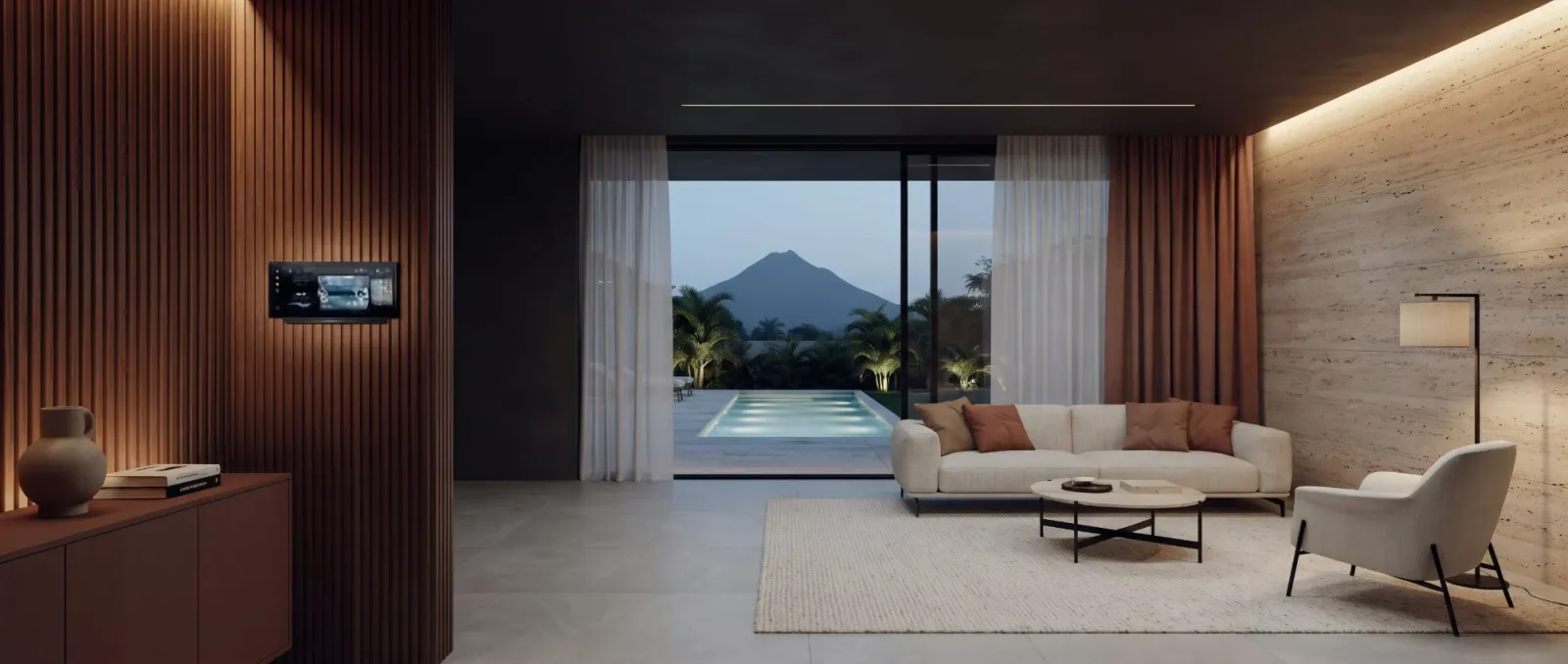
Imagine a full day in a residence with Dommux infrastructure.
It is not science fiction or a marketing fantasy: each scene rests on proven systems and on evidence we detail at the end. First the story; then, what is behind it.
The morning (6:00–7:30 a.m.)
The blinds open gradually and the light turns warm, imitating the sunrise; your music starts at a gradually rising volume. There is no alarm to jolt you awake: the house wakes you with a natural transition. In the bathroom, the lighting is calibrated so it doesn't strain your eyes, the water arrives at just the right temperature and breakfast is waiting for you because the coffee maker switched itself on.
While you work (9:00 a.m.–5:00 p.m.)
When you leave, the property goes into protection mode: lights and climate off and the status of your alarm in plain view. If the cleaning staff come in, you generate a temporary access code that expires when they finish.
Coming home (6:00–9:00 p.m.)
You mark your arrival and the welcome begins: the gate opens, the lights guide you, the climate adjusts and your usual music plays. At dinner, an intimate scene of warm light; later, cinema mode: the lights go down, the projector lowers and the sound calibrates itself.
The night (10:00 p.m.–6:00 a.m.)
Night mode takes the lights to warm tones, checks that doors and windows are closed and leaves the nighttime route at minimum intensity. While you sleep, the sensors keep watch and the system optimizes consumption.
What is behind it (the evidence)
That day is not magic; it is engineering backed by data.
Light that accompanies your day. Circadian lighting — warm at dawn and dusk, neutral during active hours — follows the logic of circadian rhythms; the quality of light and of the indoor environment has a documented impact on well-being and rest (World Green Building Council).
Real savings. The international reference puts the savings of a well-executed integration at 20-30% less energy on climate control (ISO 52120-1); the real figure depends on each home. It is not an extra: it shows up on the bill.
Security that pays for itself in peace of mind. In the luxury segment, state-of-the-art security — biometric access, intelligent video surveillance — is no longer a plus: it is expected, and buyers pay a premium for the peace of mind it brings (The Pinnacle List).
Asset value. Integrated intelligent technology increases the value of a property — the National Association of Realtors documents rises of 3-5% — and, in luxury, integrated intelligence stopped being a luxury and became an expected standard (Redfin; The Pinnacle List). (Figures from international markets; a reference for direction.)
In El Salvador the category has already crossed the threshold: Statista projects home technology penetration rising from 51.5% to 62.4% between 2025 and 2029, with the market growing from $31.1 million to $44.4 million. It is no longer something for pioneers; it is becoming what buyers expect.
The difference: an orchestra, not loose instruments
The distance between a Dommux residence and a collection of gadgets labeled “intelligent” is the same as between isolated instruments and an orchestra. The components may look similar; what changes the outcome is coordinated integration on an open standard (KNX) and the ongoing service that keeps it alive. That is why we talk about infrastructure, not devices.
An honest note: this walkthrough illustrates what the system can do, not a specific installation already delivered. We are at an early stage; we describe real capabilities, without attributing to ourselves cases that do not yet exist.
References
- The Pinnacle List — Intelligent technology and luxury real estate (2024)
- Redfin — Integrated technology and property value
- World Green Building Council — Health, Wellbeing & Productivity (light and indoor environment)
- Statista — Home technology — El Salvador (penetration and market projection)
Note: value and savings figures based on international studies and markets; magnitude varies by home and project.