Product vs. project: what a developer should demand when integrating intelligence
“Intelligent” has become an easy label.
But there is a chasm between placing imported devices and building the intelligence of a building. For a developer, confusing the two is not a technical detail: it is a risk to the asset and to the buyer’s trust.
The device graveyard
In the world of consumer residential intelligence there is a pattern that repeats: the company that sold the device decides, one day, to switch off the cloud that made it work. And the device, which the customer thought was theirs, becomes a brick.
These are not isolated cases. Belkin announced the end of support for a good part of its Wemo line starting in January 2026: plugs, switches and the rest will stop being controllable from the app. Insteon shut down overnight over financial problems, leaving entire homes without control. Google pulled support for the Revolv hub two years after buying it, even though it had been sold as “lifetime.” Wink tried to force a subscription overnight; Lowe’s Iris closed its platform in 2019; and the list goes on (How-To Geek; Techdirt). The lesson for anyone building is uncomfortable but clear: a tower whose “intelligence” depends on imported product tied to a cloud is one outside corporate decision away from going dark.
Product is not project
The difference is one of nature, not of degree.
Product: single-brand devices, dependent on their cloud, with no integration project to unify them and no responsibility after handover. It is a purchase.
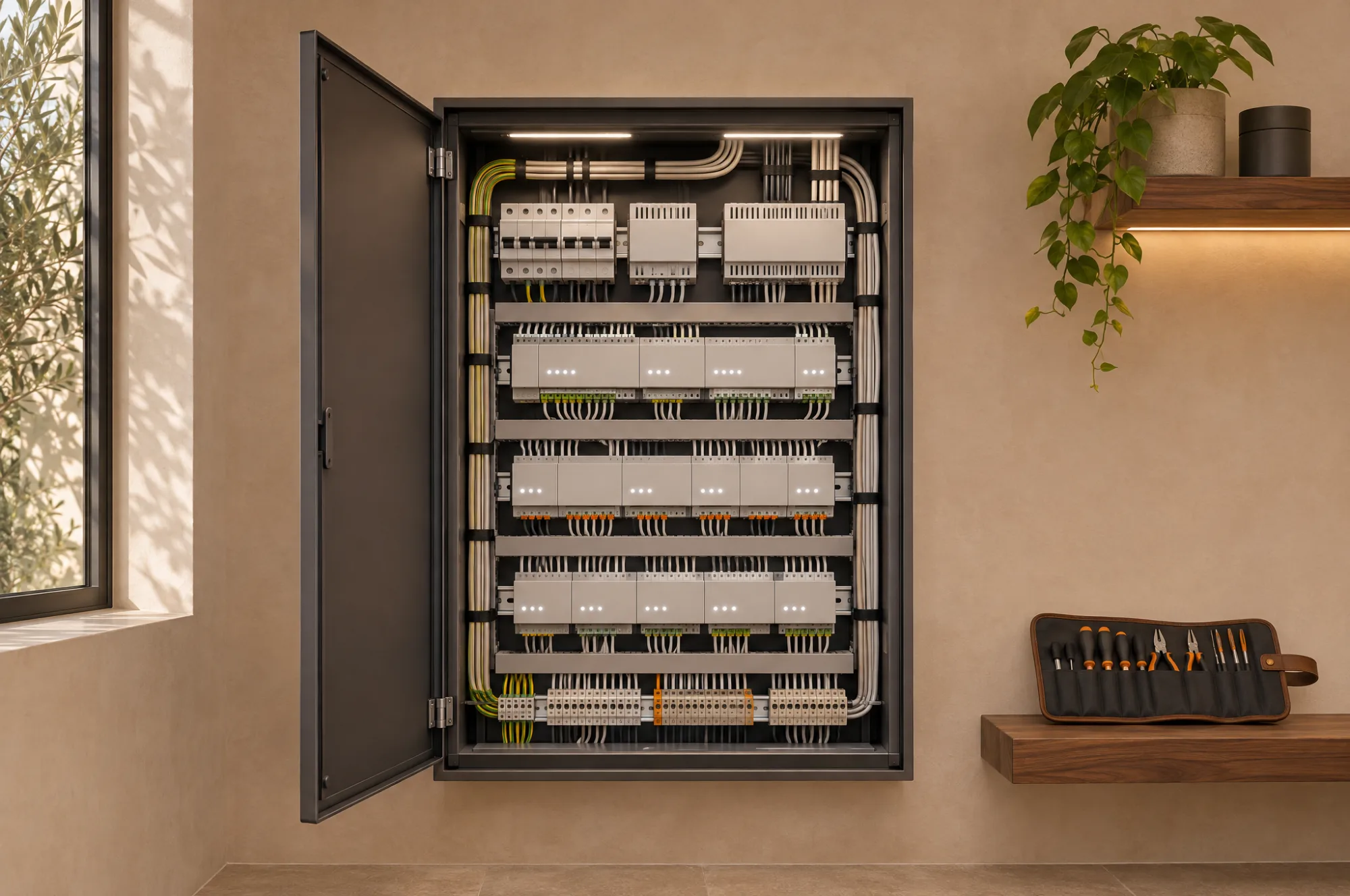
Project: all systems integrated under a single architecture, on an open standard, coordinated with construction and sustained by ongoing service. It is infrastructure.
The first expires; the second is maintained and evolves.
What a developer should demand
1. Open standard. KNX brings together more than 500 manufacturers and 8,000+ products and interoperates with other professional protocols (BACnet, DALI, etc.) (KNX Association; IFSEC). Unlike proprietary systems such as Schneider C-Bus or Dynalite (Signify), which tie the installation to a single brand and its timetable (mySmart).
2. No lock-in and anti-obsolescence. Because it is internationally standardized, with KNX, expansions and updates remain possible years later, which protects the infrastructure investment (IFSEC). Reference lifespan: 15-20 years.
3. After-sales responsibility. An integrator that stays, with ongoing service, not an importer, nor a cloud that can be switched off. The buyer does not inherit a system orphaned of support.
4. Architectural-grade design. Premium fixtures that respect the project’s aesthetics, not visible patches.
5. Integration from the plans. Coordinated with construction from the start, not added at the end.
Why it is a matter of asset value, not of devices
A building whose intelligence can be “bricked” or trapped in a single brand is a latent liability: it depreciates and erodes trust. A project on an open standard, integrated and with service protects two things at once: the value of the asset and the developer’s reputation with their buyers. Anything sold as “intelligent” that breaks in two years is not a bonus: it is a stain on the tower’s brand.
And in El Salvador the room for error is greater: in a market where construction grew 24.45% in 2025 (Central Reserve Bank), the supply of professional integration has not kept pace. Most of the “intelligence” on offer today is imported product.
The question that settles it
Before signing with any “intelligence” provider, a single question orders the decision: “is this a product or a project?” If the answer doesn’t include an open standard, absence of lock-in, after-sales responsibility and integration from the plans, it is a product. And a product, in intelligence, expires.
References
- How-To Geek — Seven brands that “bricked” their own devices
- Techdirt — Cloud-dependent devices keep ending up useless
- TechNewsWorld — Some devices headed for the “brick yard.”
- IFSEC Insider — How the open KNX protocol can support building systems integrators
- mySmart — What are open and proprietary protocols?
- KNX Association — Figures and scope of the standard
- Central Reserve Bank (via Última Hora) — El Salvador’s construction grew 24.45% in 2025