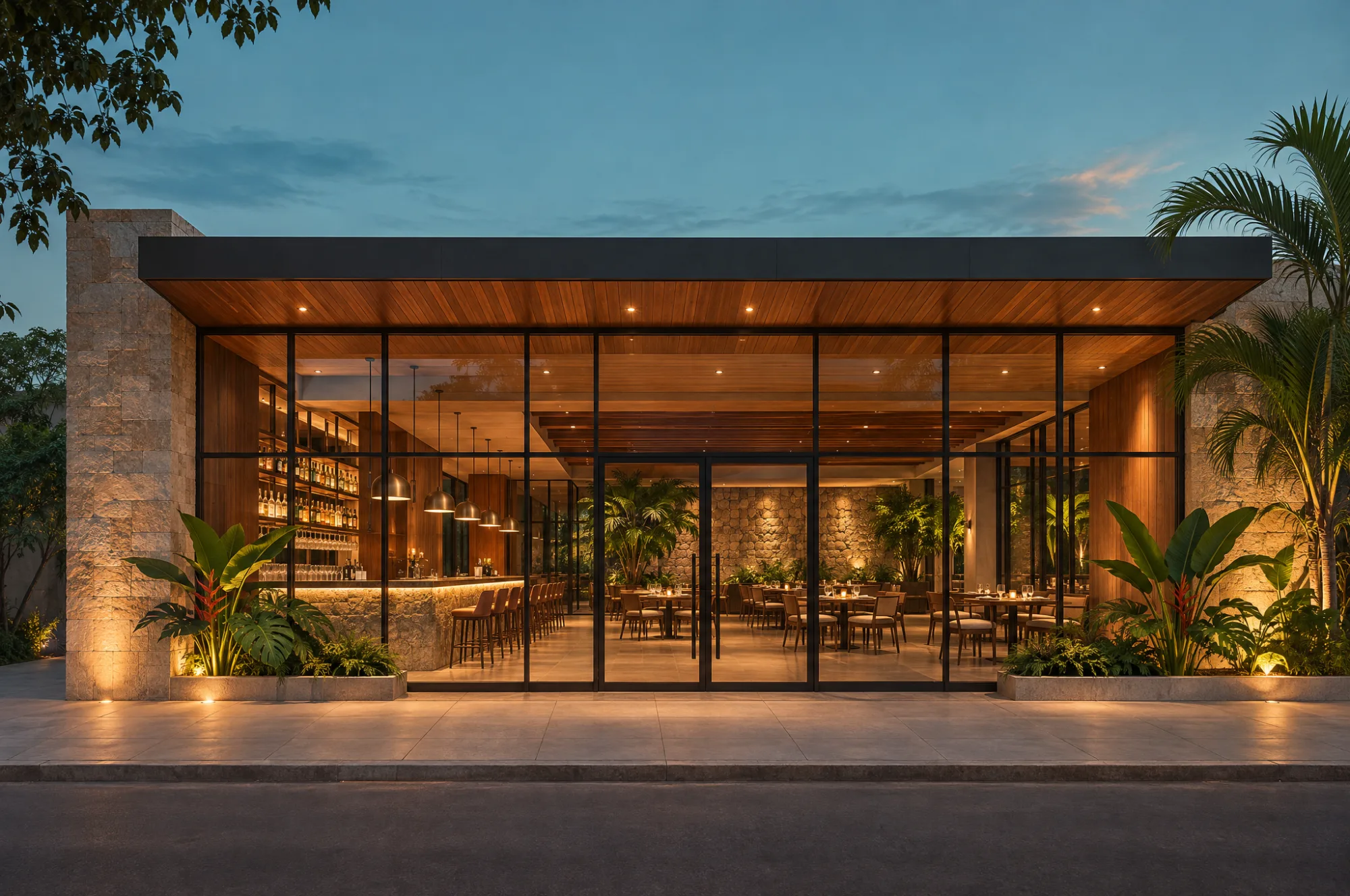
Intelligent business: professional KNX integration for corporate spaces
In a competitive environment, operational efficiency is no longer a luxury.
An intelligent corporate space is not a technology expense: it is a measurable lever on three fronts — costs, people and the value of the property. And on all three, the data back the decision.
Energy efficiency: direct impact on results
In a commercial building, climate control accounts for close to 40% of electricity consumption, which makes it the first optimization target. Here intelligence is not marginal: the ISO 52120 standard (which replaced EN 15232) quantifies by class the contribution of control systems, and the international reference for a well-executed integration is 20-30% less energy on climate control.
In practice: occupancy sensors avoid cooling empty rooms; adaptive lighting adjusts intensity and color temperature to the moment and the activity (a classic Cornell study associated ~25 °C with higher office productivity); and energy monitoring gives full visibility — a real-time dashboard and comparative reports.
People: productivity and well-being (the ROI that doesn't show up on the bill)
The biggest return is not always the energy one. The World Green Building Council documents that the design of a space has a material impact on the health, well-being and productivity of the people who occupy it. The evidence is concrete: access to natural light and views is associated with productivity increases close to 18%; Harvard University's COGfx study showed that cognitive function improves markedly when ventilation and indoor air quality go up. An intelligent space operationalizes exactly that: continuous CO₂, humidity and particle sensors that trigger ventilation with intelligent routines, circadian lighting, and meeting rooms that preconfigure themselves when booked. In personnel costs — the largest line item of almost any company — a point of productivity weighs far more than a point of electricity.
Frictionless access and zone-based security
Biometric and digital solutions (fingerprint, facial recognition, mobile credentials) replace keys and cards, and every entry is logged by date, time, person and zone — data that optimize how the space is distributed. Visitors receive intelligent temporary access (appointment verification, notification to the host, a credential limited by time and zone, check-out with no intervention), and security is differentiated by area: basic reception, data centers with dual authentication, executive zones with additional protocols.
The asset, not just the operation: rent and occupancy
For an owner, intelligence is also a lever on the value of the property. Intelligent buildings attract and retain demanding tenants, and the infrastructure not only lowers operating spend, it also improves the occupancy and liquidity of the asset.
The market timing helps: Salvadoran construction grew 24.45% in 2025 (Central Reserve Bank) and property transfers rose 12%, moving more than $3,737 million through November 2025 (CNR). There is room and there is activity.
Applications by sector
- Restaurants and hospitality: a dynamic atmosphere according to time and occupancy; light and music that accompany the service.
- Medical offices and clinics: waiting rooms that relax, professional lighting in the exam room, access control to restricted zones.
- Retail: optimal product lighting, an atmosphere that invites people to stay, discreet but effective security.
Return on investment
Adding up the three levers — energy savings, space optimization, fewer incidents and productivity and, on the asset side, higher rent and occupancy — the return depends on each building, its scope and its use. That is why we calculate it project by project, with data and without generic promises.
References
- World Green Building Council — Health, Wellbeing & Productivity in Offices
- Harvard T.H. Chan School (COGfx study) — indoor air quality and cognitive function (referenced via WorldGBC).
- ScienceDirect — Smart offices: A productivity and well-being perspective
- eu.bac — ISO 52120 (efficiency framework through intelligent control)
- Central Reserve Bank (via Última Hora) — Construction grew 24.45% in 2025, its biggest rise in almost two decades
- CNR (via El Diario de Hoy) — Property transfers +12% and $3,737 million through November 2025
Note: the savings and productivity figures are based on international studies and markets; they are used as a reference of magnitude, not as Salvadoran data. The construction and property transfer data are from El Salvador (BCR, CNR).