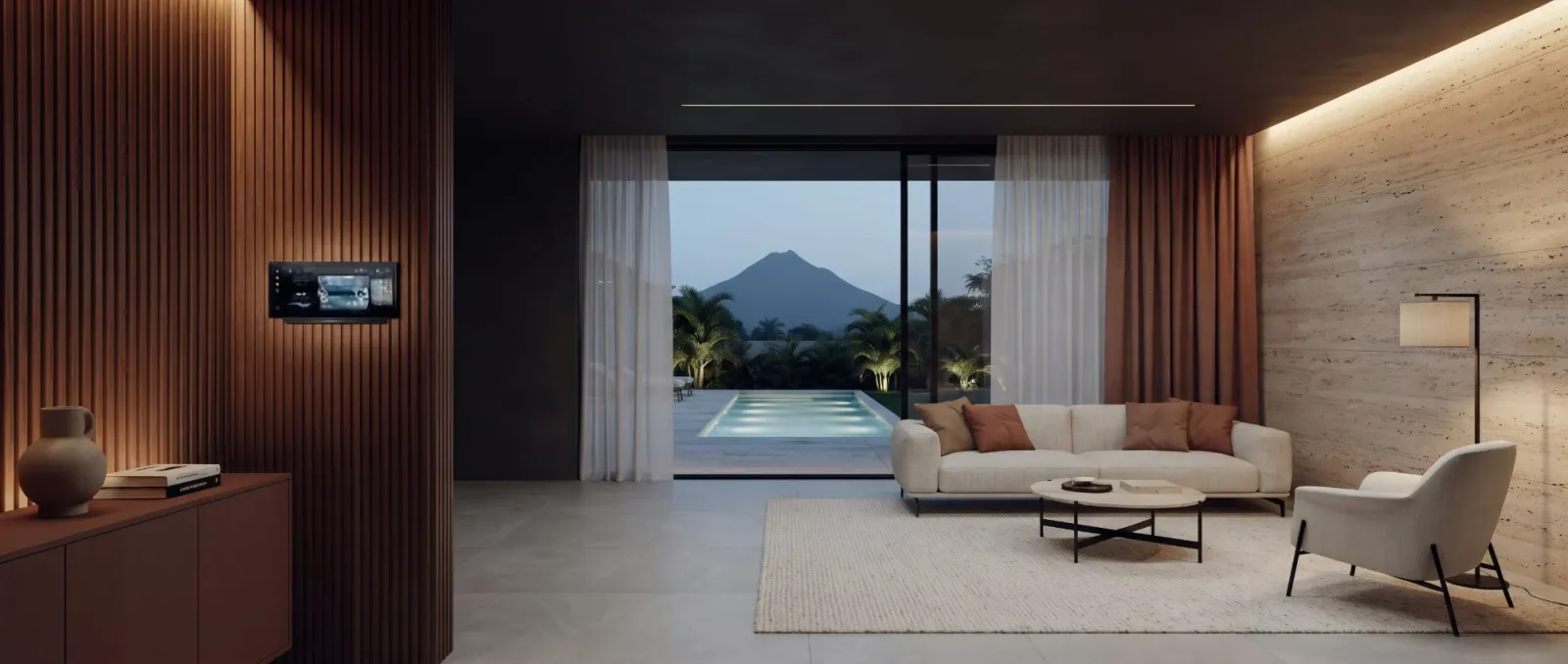
Comfort is not a luxury: it is designed.
Temperature, humidity, air and light shape how we rest and how we concentrate at home. An intelligent infrastructure doesn't “deliver luxury”: it manages those variables continuously.
The variables of comfort
Temperature, humidity, air quality, the intensity and color of light, the soundscape: every space mixes them without you noticing, and they shape how you rest and how you work. The World Green Building Council documents the impact of the indoor environment on well-being and performance; each parameter is a variable that a well-designed infrastructure manages intelligently.
Intelligent climate control: beyond the thermostat
A conventional thermostat holds a fixed temperature; an intelligent system manages microclimates by zone and by time of day. Sleep research puts the optimum for sleeping at around 18-20 °C, versus the 22-24 °C of daytime activity: the system cools the bedroom before you go to sleep and warms it at dawn. In a tropical climate like El Salvador's, humidity control (ideal 40-60%) is as important as temperature — excess favors mold and dust mites. And air quality weighs on the mind: Harvard's COGfx study showed that cognitive function improves notably with better ventilation; that is why the sensors activate ventilation when CO₂ exceeds ~800 ppm.
Circadian lighting: synchronized with your day
The 2017 Nobel Prize in Medicine recognized the mechanisms of the circadian clock — and there is now a scientific consensus that lighting should support those rhythms (Frontiers in Photonics, 2023). Conventional artificial light ignores them: a cold, intense light at night is stimulating when it is time to unwind, while a cooler morning light helps you wake up. A Dommux infrastructure turns that into a coherent day of light.
Morning: cool, intense light that stimulates activation.
Midday: neutral temperature for concentration.
Evening: transition to warm tones, which support rest.
More scenes for every moment — reading, dinner, cinema — on the same logic.
Distributed audio as well-being
The soundscape influences stress, concentration and mood. Multiroom audio distributes, in each zone, what the moment calls for: nature sounds to relax, white noise to concentrate, a gradual fade to prepare for sleep.
Natural light and sun protection
Intelligent curtains and blinds manage natural light: gradual opening to wake up, the best daytime position to avoid glare, closing at night for privacy and insulation. In the tropics, sun protection calculates the angle according to the position of the sun and the temperature, blocking direct radiation without giving up diffuse light.
The orchestra of comfort
The real power is not in each system on its own, but in their coordination. Well-tuned instruments played apart, or a symphony: integration on an open standard (KNX) is what turns isolated parameters into a coherent experience of well-being.
References
- Frontiers in Photonics (2023) — Lights should support circadian rhythms: evidence-based scientific consensus
- World Green Building Council — Health, Wellbeing & Productivity (indoor environment)
- SLEEP / Oxford Academic — Circadian-informed lighting improves vigilance and sleep
- 2017 Nobel Prize in Physiology or Medicine — mechanisms of the circadian clock (Hall, Rosbash, Young).
Note: temperature/humidity ranges and the CO₂ threshold follow the comfort and air-quality literature; optimal values vary by person and home.